
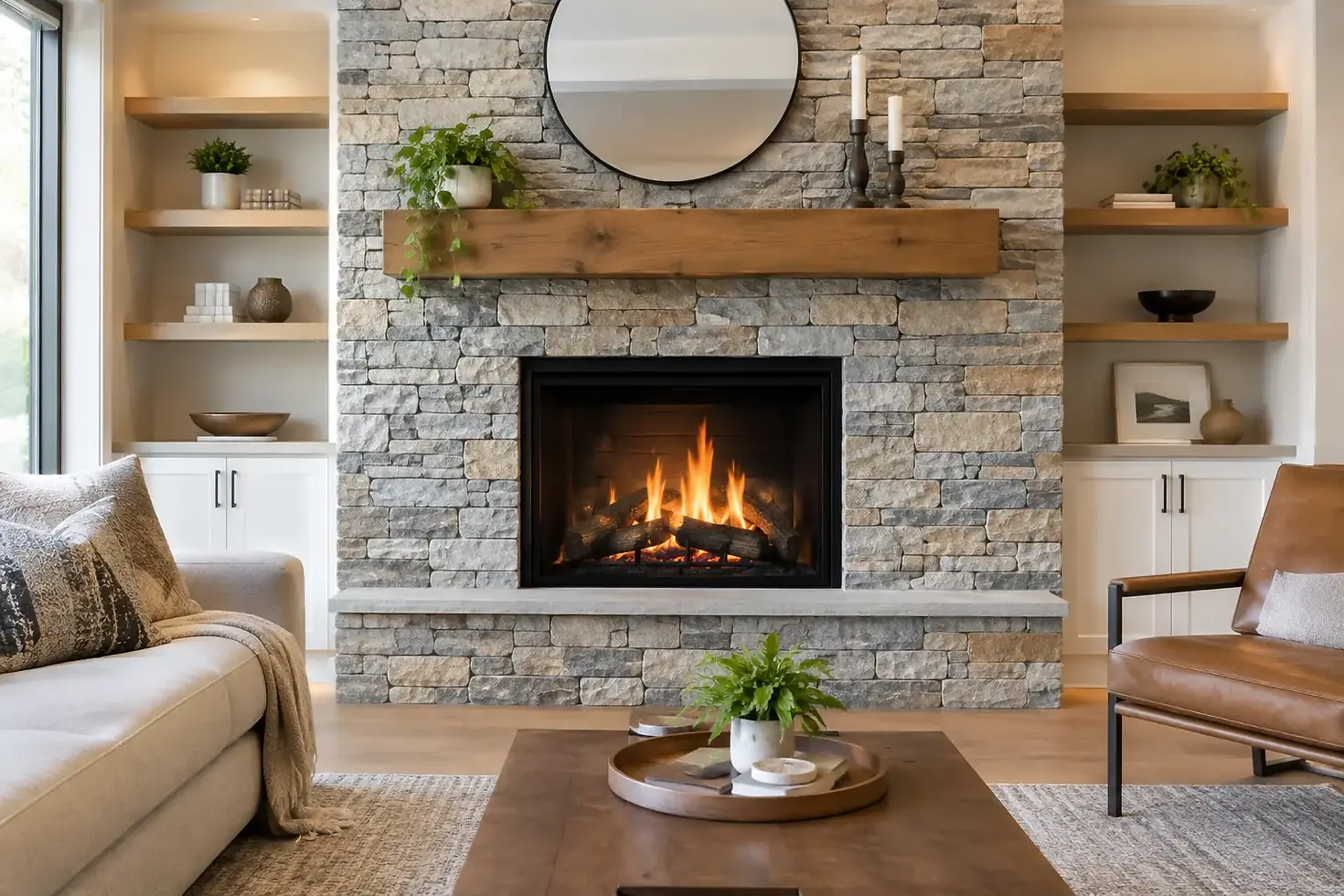
A Modern Stone Fireplace Surround for Your Home
A fireplace can either anchor a room or interrupt it. The difference often comes down to proportion, material selection, and the care taken where the stone meets the firebox, mantel, floor, and adjacent walls. A modern stone fireplace surround brings visual weight and lasting character to that central wall, but it should feel intentional rather than simply oversized or expensive.
For a Connecticut home, the strongest result is usually one that balances architectural clarity with the way the room is actually used. Whether the fireplace sits in a formal living room, an open kitchen-family room, or a quiet primary suite, custom stonework gives the feature a finished, permanent quality that painted drywall or prefabricated panels rarely achieve.
Start With the Fireplace Wall, Not the Slab
The most successful fireplace designs begin with the entire wall in view. Before choosing a color or stone pattern, consider ceiling height, window placement, built-ins, furniture layout, and the visual presence of the hearth. A tall room may support a full-height installation, while a lower-ceilinged room can feel more balanced with a focused surround and a simpler finish above.
Modern design does not always mean minimal stone. It means every line has a purpose. A broad horizontal surround can make a long, low firebox feel grounded. A vertical installation can draw the eye upward in a room with vaulted ceilings. In either case, the stone should relate to the room's existing geometry rather than compete with it.
This is also the point to decide whether the fireplace is meant to be quiet or commanding. A restrained surround in a soft, consistent tone can support artwork, cabinetry, or a view outdoors. A dramatic natural slab with pronounced movement can become the room's defining feature. Neither direction is automatically better. It depends on how many other focal points already exist in the space.
Choosing Stone for a Modern Fireplace Surround
Material affects more than appearance. It influences the level of variation, the feel of the finished surface, and the practical details a fabricator must address during layout and installation.
Granite is a dependable choice for homeowners who want natural depth, durability, and a surface that holds up well around an active hearth. Its pattern can range from subtle and uniform to bold and highly expressive. For a contemporary room, a quieter granite with a honed finish may create a more tailored look than a heavily polished, high-contrast selection.
Quartz offers controlled color and pattern, which can be especially useful when the fireplace needs to coordinate closely with kitchen countertops, built-ins, or a clean-lined feature wall. Its consistency supports crisp, architectural designs. Still, quartz is not appropriate for every application near direct heat. The fireplace type, required clearances, and manufacturer guidance should be reviewed before it is specified.
Natural stone remains appealing because no two pieces are identical. Veining, mineral variation, and movement can make a surround feel collected rather than manufactured. The key is thoughtful slab selection and layout. A beautiful slab can lose its impact if its most compelling details are cut away, interrupted at a seam, or placed where they do not read from across the room.
Finish Changes the Character of the Stone
A polished finish reflects light and can make a room feel brighter and more formal. It works well when the goal is refined contrast, particularly against matte wall paint, warm wood, or textured upholstery. Honed finishes soften reflection and often suit homes leaning toward relaxed contemporary or transitional design.
Leathered and textured finishes add tactile interest, but they are not automatically the modern choice. They work best when the surrounding palette is otherwise clean and the stone's texture has room to register. In a room already filled with visible grain, patterned fabric, or rough-sawn wood, a smoother surface may provide needed visual calm.
Scale, Seams, and Edge Details Matter
A modern stone fireplace surround often succeeds because the details are nearly invisible. Clean reveals, carefully planned seams, and disciplined edges are what allow the finished wall to feel integrated.
Whenever possible, large-format pieces minimize visual interruption. A single slab behind a linear firebox can create a dramatic, continuous field of stone. However, the best seam plan depends on slab dimensions, the fireplace opening, access to the room, and the stone's natural pattern. Trying to eliminate every seam at all costs can lead to unnecessary compromises elsewhere. The better approach is to place seams where they are least noticeable and where the pattern can transition naturally.
Edge profiles deserve the same attention. A squared edge with a small eased detail suits most modern installations because it looks precise without feeling sharp. A thicker mitered edge can add substantial presence to a floating hearth or mantel while preserving a clean silhouette. More decorative profiles can be appropriate in traditional homes, but they may work against the streamlined intent of a contemporary design.
The hearth itself should be designed as part of the composition, not as an afterthought. A projecting hearth creates a practical perch and defines the fireplace zone. A flush hearth can feel more architectural and allows flooring to remain visually continuous. Building codes, appliance requirements, and room circulation all influence which option makes sense.
Consider the Mantel and Surrounding Materials
Stone does not need to cover every inch of the wall to make an impact. In fact, pairing a stone surround with painted drywall, wood paneling, plaster, or tailored millwork can produce a more balanced result. The transition between materials should be deliberate, with aligned edges and a clear hierarchy.
A wood mantel can warm up cool-toned stone and create a welcoming contrast. A stone mantel can deliver a more monolithic, gallery-like appearance. For a truly minimal look, some homeowners choose no mantel at all, but that decision should account for the room's practical needs and the manufacturer's clearance requirements.
If a television will be mounted above the fireplace, plan for it early. The firebox location, heat management, viewing height, wiring, and stone layout all need coordination. A surround that looks ideal in an elevation drawing can become awkward if the television is mounted too high or cables are introduced after fabrication. Early planning protects both the design and the finished surface.
Why Professional Fabrication and Installation Are Essential
Fireplace stonework calls for more than an attractive material. Openings must be measured accurately, cutouts need clean edges, and every piece must arrive ready to fit the wall as designed. Slight inconsistencies in framing, flooring, or firebox placement are common in renovation work. A custom fabrication process accounts for those real-world conditions rather than assuming the room is perfectly square.
Professional installation also matters for alignment and safety. The stone must be properly supported, transitions need to be clean, and material selections must suit the heat exposure of the specific fireplace system. This is where design choices become construction details, and where experience prevents a striking concept from becoming a difficult installation.
For builders and designers, a coordinated stone partner can also help keep decisions moving. Confirming slab layout, edge treatment, dimensions, and installation sequencing before fabrication reduces last-minute changes that can affect other trades. For homeowners, that process replaces uncertainty with a clear path from inspiration to a finished focal point.
A Few Design Directions That Age Well
A full-height slab surround with subtle movement is well suited to a contemporary great room, especially when the firebox is long and linear. It creates a strong center without relying on extra ornament.
For a softer transitional interior, a simple stone surround paired with a substantial wood mantel offers structure and warmth. The stone can remain quiet while the mantel provides contrast and a place for seasonal styling.
In a smaller room, consider a low-profile surround with a flush hearth or no hearth extension. Limiting the footprint can make the fireplace feel intentional without allowing it to overwhelm nearby seating or walkways.
The common thread is restraint. A modern fireplace should not depend on trend-driven details to feel current. Strong proportions, quality material, and precise fabrication will carry the design much further than an overly complicated arrangement.
A fireplace is one of the few architectural features you see every day and gather around year after year. Take the time to view full slabs, study the room from multiple angles, and make decisions with both the firebox and the finished wall in mind. When the details are resolved early, the final stonework feels less like an addition and more like it has always belonged in your home.


Comments